DEC • DYNAMIC ENVIRONMENTAL CORPORATION SPA
Via Lepetit, 8
20045 Lainate (MI) (Italy)
Tel. +39 02 45071511
sales-global@DEC.group
https://www.dec.group/
Linkedin: https://www.linkedin.com/company/DEC-Dynamic-Environmental-Corporation/
Youtube: https://www.youtube.com/@DEC-Dynamic-Environmental-Corp
Facebook: https://www.facebook.com/DEC.Dynamic.Environmental.Corporation/
MANAGEMENT
Andrea Formigoni, CEO
https://it.linkedin.com/in/andrea-formigoni
Davide Signorelli, Technical Sales & Applications, Vice-President
https://www.linkedin.com/in/davide-signorelli/
Fabrizio Imarisio, Technical Sales & Applications, Vice-President
https://www.linkedin.com/in/fabrizio-imarisio/
Mouna Feki, Technical Sales and Applications, Manager
https://www.linkedin.com/in/mouna-feki/
Andrea Benvenuti, Technical Sales and Applications, Engineer
https://www.linkedin.com/in/andrea-benvenuti-ing/
Xihai Cao, Technical Sales and Applications, Engineer
https://www.linkedin.com/in/xihai-cao/
BUSINESS SECTORS
Machines and equipment for printing & converting
PRODUCT RANGE
DEC develops cutting edge technological solutions to guide industries toward sustainability, optimizing production processes and drastically reducing volatile organic compound (VOC) emissions, with advanced and efficient systems for Air Pollution Control.
REPRESENTED BRANDS
THE INTERVIEW
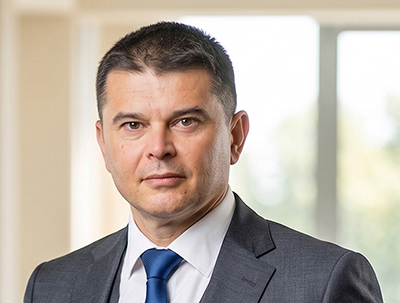
ANDREA FORMIGONI
CEO
DEC is a historic company; what vision drove DEC to invest in industrial sustainability during a time when current regulatory pressures and global ecological awareness did not exist?
When DEC began its journey, sustainability was not a legal obligation or a market trend; instead, it coincided with industrial efficiency, technological innovation, and generational foresight. Our roots trace back to the early 1920s with the development of the first technological applications using activated carbon, which were then consolidated over the last century thanks to the entrepreneurial spirit and resilience of our founding family. From the beginning, we focused every effort on developing technologies and processes for industrial air treatment. Sustainability was not born as a regulatory constraint to respect, but as the natural evolution of smart, forward looking industrial engineering.
While many companies show difficulty evolving over the long term, DEC continues to lead the sector through constant technological evolution; how is this drive toward the future cultivated within the company?
For DEC, innovation is not a goal to achieve, but represents the core principle on which our entire industrial history is founded. We cultivate this drive toward the future through constant investment in research and development, focusing on the design of advanced systems for air pollution control that anticipate global market needs.
Our engineering team works closely with Customers to transform environmental challenges into opportunities for energy and operational efficiency; a clear example of this approach is the development of our solvent recovery units and regenerative thermal oxidation systems. We do not just replicate existing technologies; we constantly study and optimize thermodynamic and adsorption processes to guarantee superior performance. This attitude of continuous evolution is passed down from generation to generation, allowing us to maintain a solid and globally recognized technological leadership.
DEC boasts thousands of projects globally; what does the concept of experience mean concretely for your company, and how does it translate into value added for the market?
Throughout the industrial history of DEC, we have designed thousands of systems in every corner of the world, facing every operational condition. This extensive base of installed systems represents a unique information asset; thanks to operational data collected over time, we have the ability to constantly optimize every process.
Today, we can apply and test new technologies simultaneously across dozens of active plants, monitoring the performance of new processes in real time and under different operating conditions. This scientific approach allows us to measure the real effectiveness of each innovation, refining engineering configurations with extreme precision and immediately transferring these technological benefits to our Customers.
The sector of VOC, volatile organic compounds, emissions treatment is experiencing a profound transformation, driven by increasingly strict regulations and integration with industrial decarbonization projects; what are the global macro trends that you are observing, and how is DEC guiding the development of new processes to meet these needs?
Currently, not all markets experience the same priorities, due to both the impact of local regulations and differing energy costs. Today, one of the biggest challenges in the sector is the training of operators and maintenance personnel, within a context characterized by high turnover rates.
DEC develops its processes by considering first that the proposed technologies must be concretely sustainable; this means they must be easy to implement. We have our own vision called the “KISS” approach to technological development, a corporate philosophy that means “Keep It Simple & Safe”.
The “KISS” Principle: Keeping processes efficient, simple, and safe right from the engineering phase allows for scalability and rapid, efficient implementation on a global scale.
Experience teaches us that it is not necessary to design thermodynamic labyrinths or unnecessarily complex regeneration cycles to impress the market; true innovation lies in achieving the best results through linear design, guaranteeing maximum energy efficiency for our Customers, all without unnecessary complications.
DEC is present in over 50 countries, with a commercial structure that supports Customers globally; how are you structured in Europe and around the world?
DEC is a historic company, 100% Italian; we are present in Europe with offices in Italy, Switzerland, and Luxembourg. For Asia, we have our headquarters in Shanghai, China. We have four production centers located in different areas of the world, including Italy, Egypt, India, and China. In a constantly evolving market with strong pressures on supply chains, we must balance logistical needs and production costs, always operating without quality compromises and keeping key materials coming from the Italian supply chain, always preserving our origins and protecting “Made in Italy”.
THE PRODUCTS
DEC develops, designs, and supplies advanced technological solutions to guide industries toward sustainability, optimizing production processes and drastically reducing volatile organic compound (VOC) emissions. With thousands of completed projects and a widespread presence in over 50 countries, we are the reference partner for sustainable projects in Air Pollution Control (APC).
Technologies and Engineering Solutions
The technological portfolio of DEC is structured around high efficiency systems; each plant is designed to meet the specific needs of the Customer, ensuring environmental compliance and a rapid return on investment.
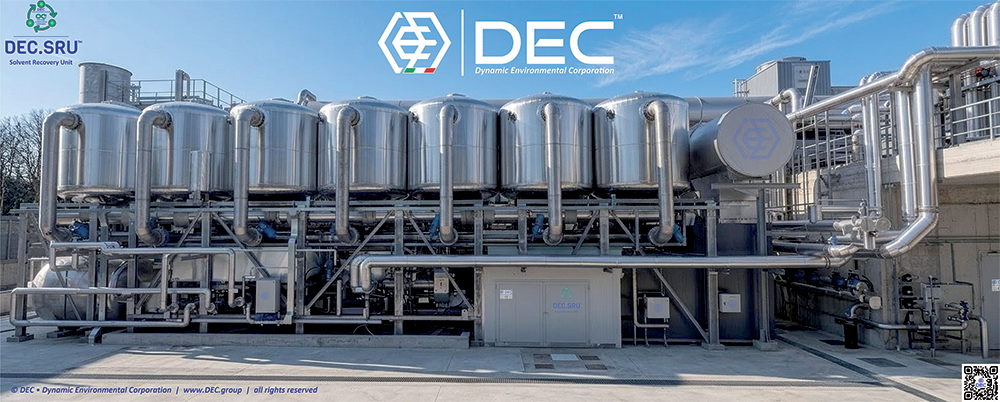
Solvent Recovery Units (SRU): these units represent excellence in the circular economy; they allow the capture of industrial solvents present in gas streams, purifying them and making them available again for the production cycle.
Regenerative Thermal Oxidizers (RTO): systems designed for the thermal destruction of atmospheric contaminants; energy efficiency is maximized thanks to an integrated heat recovery system, which minimizes the consumption of auxiliary fuel.
Rotary Bed Concentrators (RBC): this technology is ideal for treating large volumes of air with low solvent concentrations; the system concentrates the pollutants before the final treatment, optimizing operating costs.
Distillation Systems (DST): advanced solutions for the separation and purification of liquid mixtures; they allow the fractionation of recovered solvents to achieve the purity levels required by industrial processes.
Service, Optimization, Revamping, and Retrofit
The operational life of a plant requires constant updates to maintain maximum performance levels; through the DEC SERVICE division, the company offers comprehensive maintenance services, technical assistance, and remote monitoring.
The revamping and retrofit activities focus on the technological renewal of existing systems; the interventions are aimed at maximizing the energy efficiency of the plants, reducing the carbon footprint and the consumption of fuel or electrical energy. Thanks to these structural upgrades, legacy plants are adapted to the most stringent environmental regulations in force, extending their life cycle, minimizing operating costs.
A Reliable Partner for the Customer
Choosing DEC means relying on a structured partner capable of managing the project in its entirety, from initial engineering design up to final commissioning and subsequent maintenance; contractual transparency and technical reliability are the pillars on which the relationship with each Customer is founded.