A fully digitalized rotogravure printing process to make it competitive even on 5,000-metre runs with 70% reduction in setup time, 50% reduction in ink waste, faster time-to-market and easier work for the operator. Bobst R&D objectives and results.
The advantages and disadvantages of rotogravure printing are well known, as is the increasingly pressing need to rationalise workflows and costs, forcing suppliers of this technology to address the major issues that make it less competitive, especially on increasingly short runs. Bobst has taken up the challenge by developing a system that has attracted the attention of operators and won the recent GRA International Gravure Award: a solution that ensures the proverbial quality levels of rotogravure with unprecedented simplicity, without the need for highly specialised operators.
The most obvious innovation is that the set-up is carried out offline rather than with the machine stopped via the control panel, and that the system automatically selects the most suitable parameters for the new job, greatly simplifying the operator’s life. Once this is done, all you have to do is ‘press a button’ to start the new job, storing everything you need for any future reprints.
A modular and integrated architecture
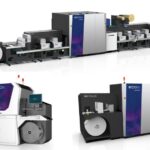
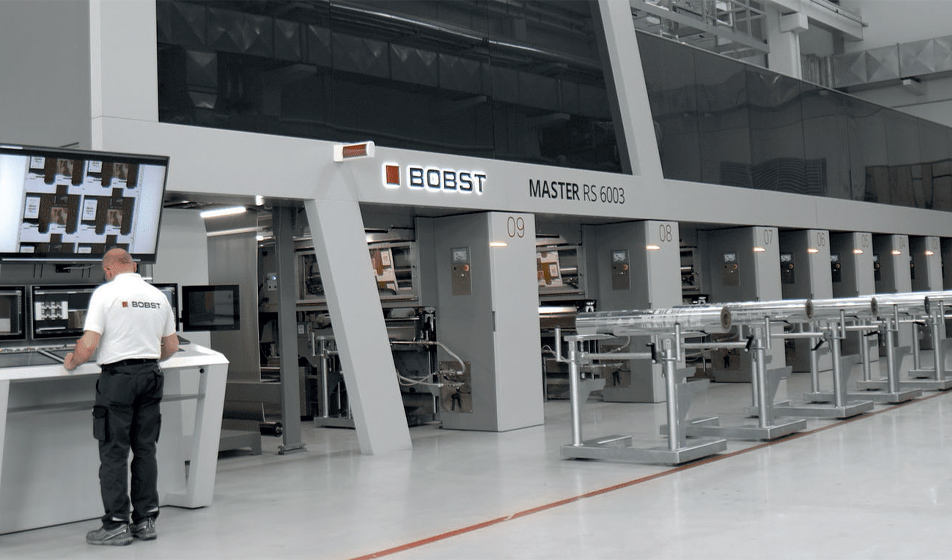
smartGRAVURE is a technology developed by Bobst for the MASTER 6003 rotogravure platform, which digitalizes the entire production flow, transforming a traditionally highly manual process into a more automated and data-driven system. Its modular architecture consists of three synergistic components: oneSET for automated setup, onePRINT for in-line colour control and oneECG for fixed palette Extended Colour Gamut management. Furthermore, its integration into BOBST Connect enables digital management of print recipes, transferability of machine parameters and complete traceability of production data.
Setup automation
oneSET automates machine configuration based on order files (PDF). Using proprietary algorithms, the system:
- automatically calculates the optimal production speed according to the characteristics of the job;
- sets the substrate tensions and drying temperatures;
- activates ‘ECO mode’ to reduce energy consumption;
- generates a digital recipe that can be transferred to the print queue with a single click.
Preparation takes place offline in prepress, freeing up press time and reducing dependence on individual skills, while digitisation eliminates input errors and operational variability.
Automated colour control
onePRINT introduces a closed-loop system by interfacing a new inking system, a colour preparation system and an in-line spectrophotometer system to automatically read and correct colour on the press. Primary colours are measured in real time and compared to the LAB references and optical density defined in the digital recipe. If necessary, a colour management algorithm calculates the exact correction and automatically sends instructions to the ink formulation.
The new mixtures are used in subsequent refills, ensuring continuous colour stability from the first to the last printed metre. For its part, the inking circuit has been redesigned to reduce the volume of ink in the machine by more than 50% compared to conventional rotogravure solutions, with a proportional reduction in waste.
Extended Colour Gamut with fixed palette
Well known to industry professionals, oneECG uses a fixed palette of up to seven colours; during job changeovers, only the printing cylinders are replaced, while the inks remain in the press. Colour matching is digitalized and shifted to pre-press. Register stability is ensured by the new Register+ system, which allows both sides of the web to be controlled simultaneously. The MASTER 6003 system with oneECG technology is officially Pantone-validated, confirming compliance with international colour standards.
Benefits in figures
The adoption of smartGRAVURE produces documented results, which Bobst summarises in a few significant figures:
- reduction in downtime for job changeovers up to 70%;
- reduction in ink waste up to 50%;
- reduction in ink volume in the machine circuit >50%;
- 100% job repeatability;
- profitable production even for runs of around 5,000 m².
The combination of offline set-up, automatic colour control and fixed palette increases press uptime, stabilises quality and reduces the need for manual intervention. Finally, full digital traceability of process colours eliminates the use of leftover spot ink mixtures typical of traditional gravure operations, improving quality control and sustainability.