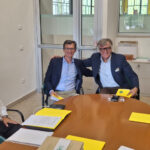
Machinery profiling, balancing of printing technologies, advanced ink management, information systems revolution and machines and services automation… Process optimization as a lever to contain costs by ensuring constant quality, compliance with standards and the continuous advancement of industry skills. Interview with Niso Bartolucci, Di Mauro Officine Grafiche.
As is well known, the flexible packaging market is going through a phase of stable consumption and margins pressure, with a reduction in the average price per square meter on most products and the persistent rise in the price of raw materials, making the life of converters more and more difficult. In this scenario, competition is increasingly played out on the ability to review process management in light of a strict cost control.
Di Mauro Officine Grafiche SpA does this supported by a development strategy that opens up new markets, overhauling information and IT flows and revolutionising the work in the printing line. Niso Bartolucci, chemist by training and process expert by field experience, Sustainability Manager and member of the board of directors of the Gualapack group, tells us about it.
Dr. Bartolucci, adverse market conditions force players to review their schemes. What’s the name of the game?
Process efficiency, today more than ever. Volumes, all in all, are holding up, but average price is falling and margin shrinking. In this context, we cannot afford any inefficiency: every metre of waste, every useless start-up, every colour error has a direct economic impact.
What choices have you made to address a problem that affects the entire operational flow?
At a general level, we are revolutionizing the computerization of the company, abandoning our historical system to migrate to a more modern and integrated platform. It will be a long, complex but necessary transition, which will allow us to have immediate control over quotes, warehouses, consumption, production data, maintenance…
And to take a leap forward in economic management too, because you cannot govern costs without having access to reliable and fast data.
Are you also investing in Artificial Intelligence?
AI is already integrated into our machines: it regulates parameters, optimizes processes, collects data. The real leap will be integrating these data at the management level; when speed, consumption, waste and machine downtime come together in a single system, it is then possible to make decisions based on real numbers.
What about the plant?
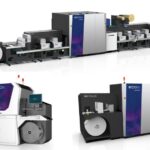
We have done a lot of work on the integration of internal and external prepress, cylinder production and printing. All our machines are profiled and equipped with spectrophotometers and this, among other things, allows us to predict the final result from the digital test.
Today we can reach a 95% test-to-print correspondence; this drastically reduces set-up times and waste and, considering that a single machine pass uses 100–120 meters of material, it also reduces costs and improves customer service.
Fewer machine corrections and more upstream control…
Exactly. If the digital test is not convincing, it is corrected in pre-press, with much lower costs than doing it on board the machine. In printing you have to produce, not experiment: this approach has significantly reduced time, waste and consumption.
Are you also working on ink management?
Yes, that’s a typical critical area and we have dedicated a lot of time, care and expertise to it, in returns management to begin with. Today, process colours are no longer “contaminated” and recoverable special colours are characterised, measured and stored.
We have a formula database that also integrates reused inks, resulting in a drastic reduction in waste and disposal costs, with several hundred thousand euros saved per year. As proof that sustainability, if done well, coincides with industrial efficiency: less wasted ink, fewer unused glues, fewer washes generate lower running costs.
What do you think of ECG?
It is an innovative approach to the critical issue of colour management, on which we have carried out experiments and keep a constant eye on. Currently, however, we have taken another path, aiming at obtaining the widest possible four-colour gamut, as an alternative to many Pantone, among other things.
Our prepress team is recording extremely satisfactory results and, in this field too, we obtained a reduction in consumables and cylinders/ plates costs.
You have recently invested in both rotogravure and flexography. What’s the logic behind this choice?
Rotogravure remains unbeatable on large productions: consistency of printing, stability of the process, competitive costs when volumes are high. Flexography is growing because, on some types of work, it allows to cut down some costs related to plates and start-up times; it is not an ideological choice, it is an industrial choice.
The customer wants to spend less, but demands the same quality and more and more brands ask us to experiment with flexo in order to be able to verify first-hand the difference in quality and cost.
In this context, is sustainability still an issue?
More: it’s the only way forward. The world is asking for recyclable packaging, simplified structures, mono-materials; the problem is that the recycling chain is not ready, especially for what concerns flexible packaging. Recycling plants are few, there is a lack of a stable market for secondary raw materials and the timeframes imposed by regulators are, in my opinion, too tight.
So there is a risk of disconnection between objectives and industrial reality.
Exactly. We do our part: we design recyclable structures, reduce waste, optimise processes. But without infrastructure investments and incentives for recycling, especially for flexible PP, it will be difficult to reach certain targets in such a short time.
In summary, what is the main lever for competitiveness today?
Industrial culture: process knowledge, data control, integration of technologies and people. Machines are important, but it’s how you use them – and how you run the company – that really makes a difference.