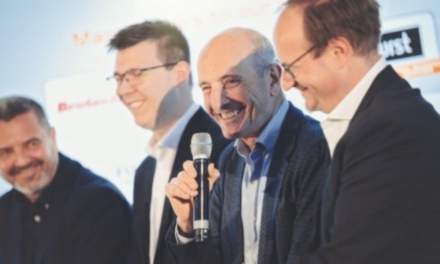
Interview with Sante Conselvan, owner of I&C-Gama Group, Past President of Atif Italia and President of FTA Europe and FTA Global Alliance, a tireless weaver of global networks with one major goal: the sharing of knowledge.
The challenges that flexographic printing faces are the same all over the world, in both “mature” and “emerging” economies, and the keystone is automation, which Artificial Intelligence is enhancing as never before. This is the premise from which Sante Conselvan’s reasoning springs, on the future of a technology, for which, despite the uncertainties of the current international context, he forecasts a further and interesting development. Building on his extensive experience as both entrepreneur and prominent figure in trade associations, intensely dedicated to fostering – with ambitious objectives – business and cultural networks and relations across all four corners of the globe.
President Conselvan, let’s start with the big trends: how is the demand for flexo solutions for flexible packaging orienting itself?
The global market moves along three very clear lines: sustainability, production flexibility and people. Brands are asking for packaging that is increasingly sustainable but at the same time coherent, reproducible and emotional, and this means new substrates, shorter print runs, greater project variability and quick response times. Thanks to advances in automation and process control, flexo is now perfectly able to meet these needs; it is no coincidence that – even in emerging markets such as India, South America, the Middle East and Africa, often dominated by roto or offset – flexo is becoming the reference technology for businesses entering the packaging market.
What are the main challenges printers are facing?
Problems are surprisingly similar everywhere, despite the different degrees of economic and social development: lack of qualified personnel, need to better integrate the prepress, printing and converting processes, and regulatory pressure on sustainability. On top of this, the market is now demanding intelligent machines that are able to provide useful data to help predict problems and reduce waste. Today printing at 500 metres per minute is not enough, the market belongs to those who control the overall process profitability.
What about Europe?
In Europe we are experiencing a phase of coordination, fueled, among other things, by the increasingly incisive actions of the sector’s institutions. As FTA Europe we have strengthened the dialogue between national associations, by sharing data, experiences and tools. Initiatives such as the Diamond Awards or the monthly thematic webinars create communities and raise the shared level of technical culture, and they are increasingly numerous and participated. The core issue, however, remains training: there are not enough schools and prepared teachers, and this is true for all countries, although to a different extent, despite the sector offering stable and qualified employment. We must let families and young people know, explaining that today workers in this sector are no longer heavy-duty labourers with ink-stained hands, they are “process operators” in white coats, with advanced technical and computer skills.
After revitalizing the European federation, you are now increasingly active on a global scale. What are the goals?
Basically, sharing knowledge: the comparison with the United States, Brazil, India, Japan or Australia confirms that we are all facing the same problems and encourages the exchange of experiences and approaches. And in the most backward areas, operators ask us: “What happened to you ten years ago, when you were at our current level of development? What did you do? This exchange accelerates the growth of emerging markets while also strengthening Europe. Moreover, while building non-commercial alliances, it creates economic and industrial opportunities.
And what about hybridization?
It is now difficult to find mono technology printers… That’s right. Flexo, rotogravure and digital are complementary tools and any entrepreneur must be ready to work with multiple techniques in order to serve a fastchanging market. Consequently, specialized associations such as Atif and FTA must on the one hand continue to develop the specific skills of flexography and on the other embrace a long-term vision: preparing for hybrid is a necessity, not a fad.
How do you translate these principles in your company?
I&C-Gama Group is now an established global provider of ink control and management solutions and we are moving towards increasingly integrated solutions. Today our portfolio of products and services includes tools for the control of pH, temperature, consumption, foam, up to the automatic distribution of inks and everything that revolves around Expanded Color Gamut. And since our customers’ goal is to obtain useful data, reduce waste and make processes increasingly predictable, we have evolved from “device vendors” to companions in a growth path that requires the right tools, advice and training support. This is how the future of flexo is built.
A future increasingly shaped by an Artificial Intelligence that profoundly changes the way companies design, produce and serve the customer, influencing the entire supply chain. What does that mean in practice?
So many things For example, integrating the operator’s experience during processing phases that determine the quality and efficiency of the process – machine adjustments, quality control, optimization of printing parameters – with an “augmented intelligence” capable of optimizing operations and reducing errors and waste. And thus also offsetting the well known lack of skilled workforce.In addition, thanks to machine learning systems, companies can move from a reactive to a predictive approach, planning production more accurately with the prediction of bottlenecks and the analysis of real costs per order. Today’s job is no longer just to “print well”, but to take better and quicker decisions.
And how are machines evolving?
They are transforming into digital platforms that collect large volumes of data (speed, tensions, viscosity, temperatures…), selfcorrect during production and learn from previous cycles. In flexible packaging this creates greater stability of results on complex and sustainable materials, a drastic reduction in start-up waste and constant quality even on short runs. But that’s not all! It allows to move from scheduled maintenance to predictive maintenance because sensors and algorithms anticipate failures, targeted interventions reduce machine downtime and in general ensure greater reliability of lines 24/7 with a clear and measurable increase in real OEE.
So services change too?
Of course. Thanks to AI, we suppliers can analyse the specific behaviour of each customer firm, propose tailor-made optimisations and co-develop new packaging applications, ensuring a continuous, adaptive and data-driven service. On top of that, the optimization of waste and energy consumption, together with the ability to better manage new ecological, “difficult” to process materials, meet the great and real need for sustainability, creating an important competitive advantage.