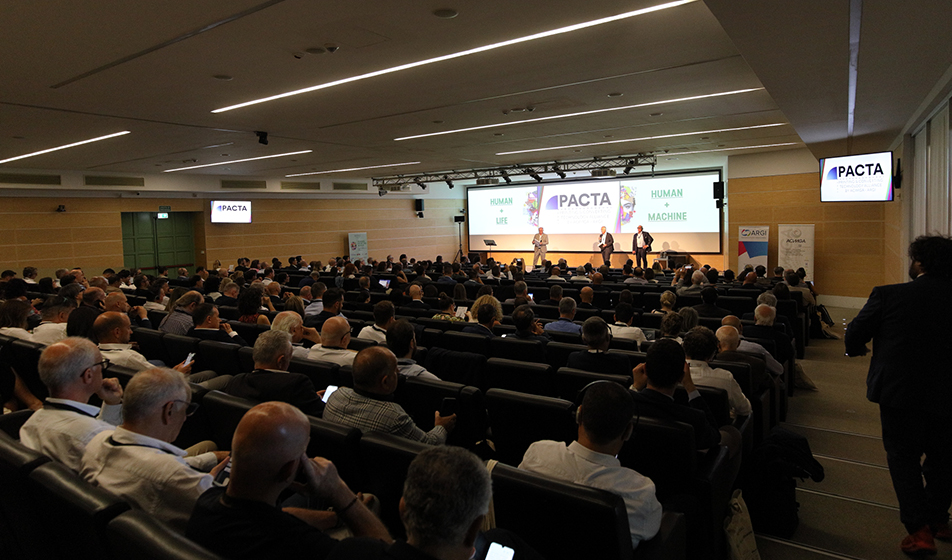
Print4All Conference 2026 in Varese confirmed itself as a working laboratory where the global printing and converting community tests its assumptions against hard data and real industrial practice. Under the “Humans Print the World” banner, the programme drilled into how Human+Machine and Human+Life translate into investment strategies, KPI frameworks and supply‑chain decisions rather than remaining a purely conceptual claim.
Around this content backbone, an informal, “Italian‑style” networking environment — from the B2B sessions to the evening party and the many side conversations in the halls of the conference — created a friendly, convivial atmosphere in which suppliers, printers and converters could build new relationships and deepen existing ones.
International deal‑making
The opening B2B session, with around seventy delegates from twenty countries, was structured as a series of fast, highly prepared meetings focused on hard numbers: volumes, cost structures, capex cycles and regional demand profiles. Discussions on cross‑application printing, automation and workflow integration quickly turned to scenarios for stabilising margin under pressure from energy and raw‑material volatility, and to the role of international partnerships in de‑risking distribution. At the same time, it served as a targeted business forum where technology suppliers and printing and converting companies could sit down face‑to‑face, test each other’s plans against market realities and open concrete negotiations on future projects and investments.
Content that shapes our space
On stage, the launch of PACTA — the Printing & Converting Technology Alliance jointly created by ACIMGA and ARGI — underlined the ambition of the the two organising associations to act as a coordinated hub for machinery, workflow and materials expertise across the value chain. PACTA’s agenda, spanning artificial intelligence, circular‑economy projects, innovative substrates and skills development, mirrors the sector’s need for a structured framework to translate technological innovation into industrial competitiveness.
AI, benchmarks and operational discipline
Artificial intelligence was treated less as a buzzword and more as a production resource that must be governed with clear decision authority, override rules and review cadence. The joint market research presented by Nathan Safran and Stefano Portolani, contrasting US and Italian adoption curves, provided the kind of comparative data that plant managers and technology providers can plug directly into their planning models: investment intensity, application areas and perceived ROI over the medium term.
Sustainability, ESG and labour data
Equally concrete was the sustainability and performance block, where case histories from Heidelberg, Petratto, TCE Printing and Uteco moved beyond generic “green” claims to examine how process efficiency, automation and materials innovation translate into measurable industrial results. Heidelberg brought the perspective of an integrated ecosystem in which connected presses, data and services support productivity and more resilient, lower‑impact plants, while Petratto focused on eliminating bottlenecks in highly automated folding‑gluing and finishing lines, showing how the human–machine relationship remains decisive even in the most digitised environments.
TCE’s contribution tackled the hard physics of sustainable production — from drying stability with water‑based inks to ink behaviour on recycled and compostable substrates — arguing that “sustainability has to be sustainable” in economic terms as well. Uteco, from the flexible‑packaging front, detailed how ESG metrics are now embedded in equipment strategy, energy‑efficiency targets and customer contracts, closing the loop between investment choices and environmental performance.
The first Italian survey on diversity, equity and inclusion in printing and converting, introduced by GWP Italia, did not yet deliver final figures but outlined methodology and research goals, since the survey is still open. In this phase, the project positions inclusivity and skills development as variables to be measured against competitiveness and innovation capacity along the value chain, rather than as purely qualitative aspirations.
Design, geopolitics and the 2027 roadmap
Sessions on inclusive packaging design showed how user research and linguistic trends are now informing converting specifications, from tactile cues to information hierarchy. The geopolitical closing keynote mapped shifting trade zones and demographic trends onto future print and packaging flows, reminding the audience that technology choices are inseparable from macro‑logistics and policy risk. In this context, Print4All 2027 at Fiera Milano was framed not simply as the next fair on the calendar but as a system platform where these data‑driven discussions will be tested against market reality.