The data presented during an industry briefing at Fiera Milano on July 3 provided more than a snapshot of Italy’s printing industry. The meeting, attended by international associations including the Flexographic Technical Association, offered insight into one of Europe’s most integrated manufacturing ecosystems and highlighted how Italy continues to contribute to the global printing and converting market. Rather than serving as a celebration of national performance, the figures point to the value of cooperation between established industrial regions, particularly Italy and North America.
A complete industrial ecosystem
One of Italy’s defining characteristics is the breadth of its printing and converting supply chain. While many countries have seen individual segments relocate or become increasingly fragmented, Italy has retained a closely connected industrial base that includes paper manufacturing, graphic production, converting, packaging and equipment manufacturing.
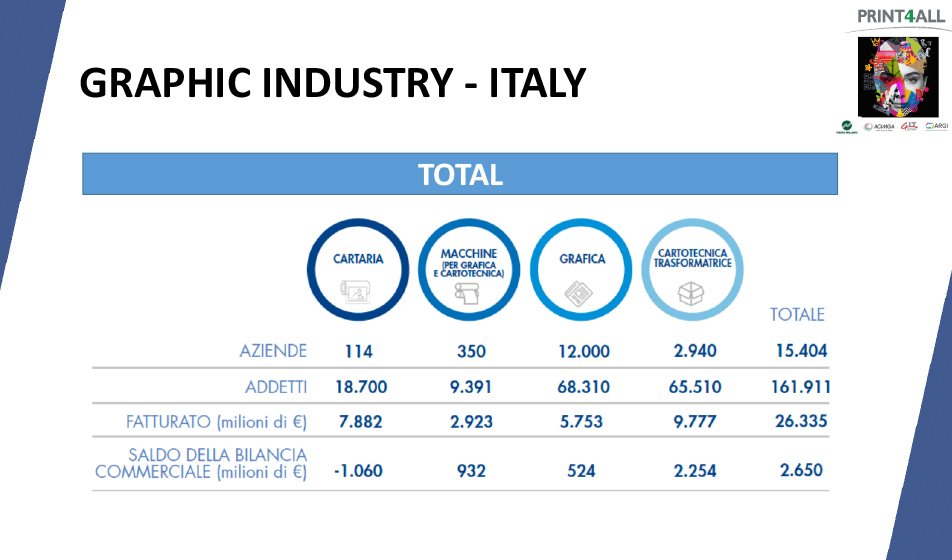
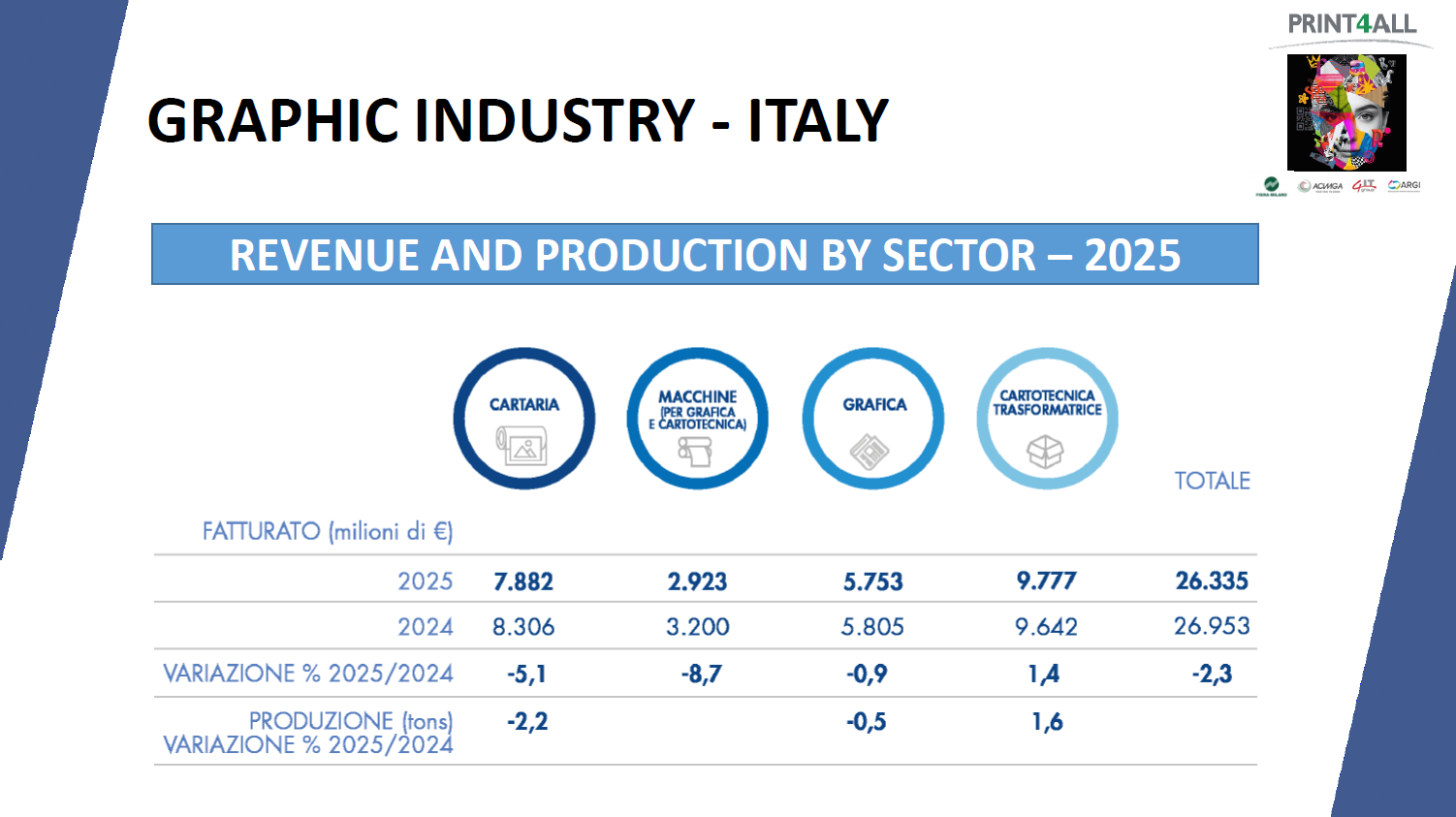
In 2025, this combined ecosystem generated approximately EUR26.3 billion in revenue. It included 15,404 companies and nearly 162,000 employees. The largest share of revenue came from paperboard converting and packaging, at about EUR9.8 billion, followed by paper production at EUR7.9 billion, graphic production at EUR5.8 billion and printing and converting equipment at EUR2.9 billion.
The value of this structure lies not only in scale, but also in proximity. Technology developers, printers, converters, material suppliers and specialized engineering companies operate within a relatively concentrated network. That closeness supports faster problem-solving, application development and the transfer of ideas from machine design to production. For a flexographic audience, this is especially relevant because packaging production increasingly depends on the integration of printing, converting, finishing, workflow software and automation.
Italy’s role in Europe
Within Europe, Italy remains one of the continent’s most substantial graphic-industry markets. The European paper and graphic supply chain represents about EUR282 billion in revenue, 113,100 companies and 1.142 million employees. Italy accounts for approximately 14% of employment in that ecosystem, second only to Germany and ahead of several other major European markets.
Italy’s position is particularly visible in equipment manufacturing. Its companies compete internationally not on scale alone, but through specialization, customization and the ability to adapt technology to specific production requirements. This is important in packaging and flexographic production, where substrate diversity, shorter runs, color consistency, waste reduction and integrated converting place increasingly complex demands on equipment.
For customers outside Europe, the Italian market therefore represents access to a broad manufacturing base capable of addressing commercial printing, labels, flexible packaging, folding carton, corrugated and other industrial applications.
Technology remains Italy’s strongest competitive asset
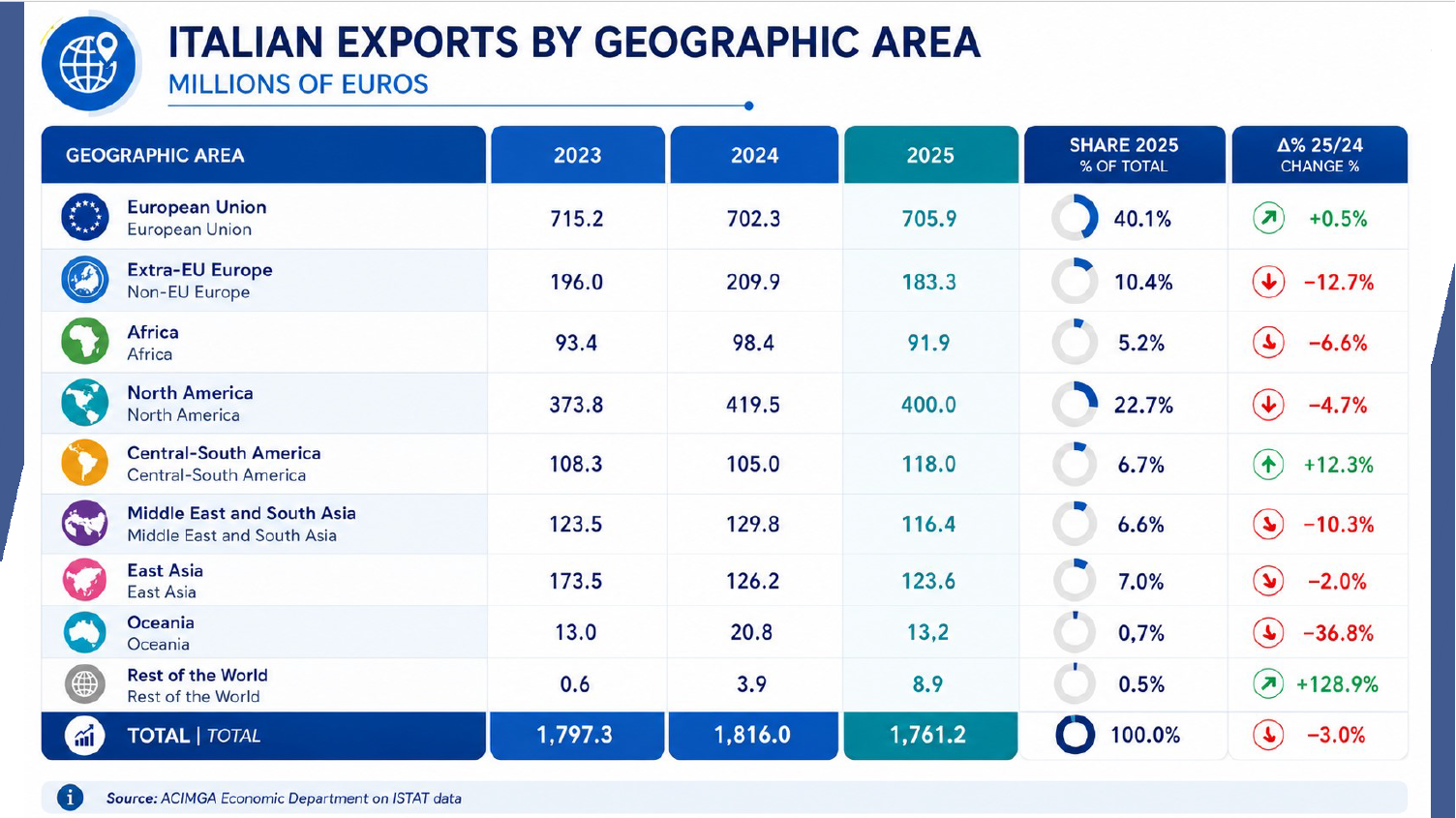
Export performance is one of the clearest indicators of Italy’s role in the international equipment market. In 2025, Italy ranked third among the world’s leading manufacturers and exporters of printing and converting machinery, with exports valued at approximately EUR1.77 billion and a 10.1% share of the global total measured in the dataset. Germany ranked first and China second.
The geographic distribution of Italian exports also shows how deeply the sector is connected to international markets. The European Union remained the largest destination in 2025, accounting for EUR705.9 million, or 40.1% of the total. North America was the second-largest region, with EUR400 million in exports and a 22.7% share. Although the North American figure was 4.7% lower than in 2024, when exports reached EUR419.5 million, it remained above the EUR373.8 million recorded in 2023.
These results are not driven primarily by low-cost, high-volume production. They reflect long-term investment in mechanical engineering, automation, application expertise and customer-specific solutions. Modern printing and converting lines increasingly combine mechanics, electronics, software, data and digital services. In that environment, flexibility can be as important as rated speed, especially when converters need to manage multiple substrates, shorter runs and changing customer requirements.
The United States: a strategic partner
Among international markets, the United States occupies a particularly important position.
As one of the world’s largest printing and packaging markets, the U.S. continues to invest in automation, digital transformation and production efficiency. These priorities closely match the technological strengths developed by many Italian machinery manufacturers over the past decades.
Rather than competing on low production costs, both countries increasingly focus on productivity, quality, sustainability and advanced manufacturing. This creates natural opportunities for industrial cooperation.
For American printers and converters, Italy represents not only a source of equipment but also a long-standing engineering partner capable of supporting highly specialized production environments. Likewise, for Italian manufacturers, the U.S. market remains an essential benchmark where innovation is continuously tested against demanding industrial requirements.
The relationship therefore extends well beyond commercial transactions, evolving into long-term partnerships based on technology, service and continuous product development.
International growth still offers significant opportunities
While traditional export destinations remain fundamental, the data also suggest that future growth may increasingly come from markets where Italian technologies are still underrepresented.
An analysis of international trade flows shows that in several countries the overall value of machinery imports is substantially higher than the share currently supplied by Italian manufacturers. This indicates considerable room for future expansion through stronger commercial relationships and deeper industrial cooperation.
The countries highlighted in the presentation—spanning Eastern Europe, the Mediterranean region, the Middle East and North Africa—illustrate this potential particularly well. They are rapidly modernizing their printing and packaging industries while increasing investments in advanced production technologies.
For the Italian industry, these markets represent not only export opportunities but also potential long-term partnerships that can support technology transfer, industrial development and sustainable growth.
Shared challenges will shape the next decade
Beyond current market figures, the presentation identified several common trends that are reshaping the global printing industry.
Automation continues to address productivity and labor availability. Artificial intelligence is beginning to support workflow optimization, predictive maintenance and production planning. Sustainability is becoming an increasingly important purchasing criterion, while the availability of skilled professionals remains a strategic issue across virtually every industrialized economy.
These are not challenges unique to Italy. They are shared by manufacturers, printers and converters worldwide, reinforcing the importance of international dialogue and collaboration.
Looking ahead
The data tell a broader story than market size alone. Italy remains a significant European manufacturing ecosystem for printing and converting technologies, supported by an integrated supply chain, engineering capabilities and a strong international presence. Its future, however, will depend not only on exports, but on the ability to build deeper partnerships across global markets.
For companies operating in North America, Italy represents more than a supplier of machinery. It is a manufacturing ecosystem that combines engineering expertise, production flexibility and long-term industrial vision. As the printing and packaging industries continue to evolve, closer cooperation between Italian technology suppliers and North American printers, converters and brand owners can create mutual opportunities for innovation, productivity and sustainable growth.