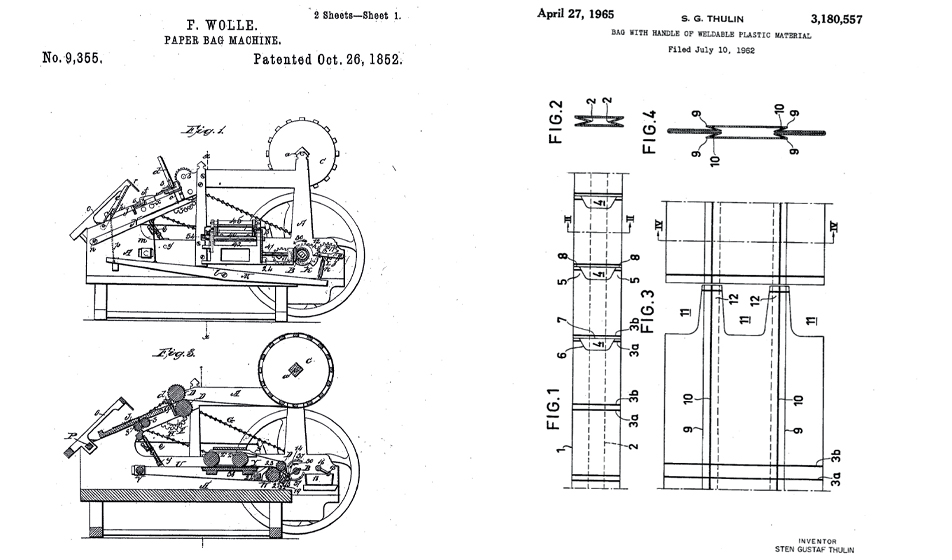
The flexible pouch, as it is defined today, has a history of over 170 years and has its origin in the paper bag. In 1851 Francis Wolle (1817÷1893) invented a machine for the industrial production of paper bags; the invention was patented on 26 October 1852 under the name “Machine for Making Bags of Paper”: US patent no. 9355. This new machine made it possible to produce 1,800 bags/h (photograph: Francis Wolle’s patent front page).
In 1871 Margaret Knight (1838÷1914) obtained US patent n.116842 for “a machine capable of cutting, folding and gluing paper to produce flat-bottomed bags”; the concept of this machine is still used today for the production of flat-bottomed paper bags. We must then wait until 1912 for a further step forward to be taken, when Walter
Deubener (1887÷1980) invented the “paper shopping bag with handle”, formed by two strings that allowed the paper bag to be easily grasped and held. In 1962 Sten Gustaf Thulin (1914÷2006) files a patent for a reusable plastic bag, the patent was granted to him in 1965 (US patent no. 3,180,557).
Thulin’s invention, contrary to the engineer’s initial idea, lead to significant plastic pollution of our Planet. Did you Know That? The first country to ban the use of non-biodegradable plastic bags was Bangladesh with a law passed in 2002; Italy joined in 2011 imposing the use of biodegradable and compostable bags.
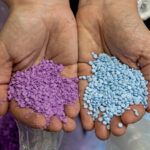
The invention of the biodegradable plastic bag is credited to Catia Bastioni (1957) who patented the invention and started the production of biodegradable bags with the company Novamont spa in 2007.