Amid shorter print runs, evolving substrates, and stricter color standards, the narrow web sector is entering a phase where efficiency, measurement and supply availability become part of the same industrial strategy
While labels remain the primary domain for narrow web, its scope is expanding into sleeves, flexible packaging, and premium applications. Smithers values the global printed label market at $44.5 billion in 2026 and $55.1 billion by 2031. Flexo and digital are the go-to technologies for pressure-sensitive labels and sleeves; furthermore, flexo remains the most widely used process on narrow web presses, accounting for over 40% of the output. This is not a linear substitution, but a growing coexistence among flexo, digital, and hybrid configurations, driven by an increasing number of SKUs and shorter runs.
Materials: cost is not the only variable
For converters, the critical focus is shifting from simple pricing to the ability to guarantee production continuity. Inks, varnishes, double-sided tapes, doctor blades, anilox rolls, and substrates must all be available within timeframes compatible with fragmented scheduling. They must also maintain batch-to-batch consistency and compatibility with evolving films, papers, and structures. FINAT reports that the European label market recovered in 2024 compared to 2023, but with volumes still hovering around 2016 levels, while energy and raw material costs continue to weigh heavily on all key markets.
Color becomes a process data point
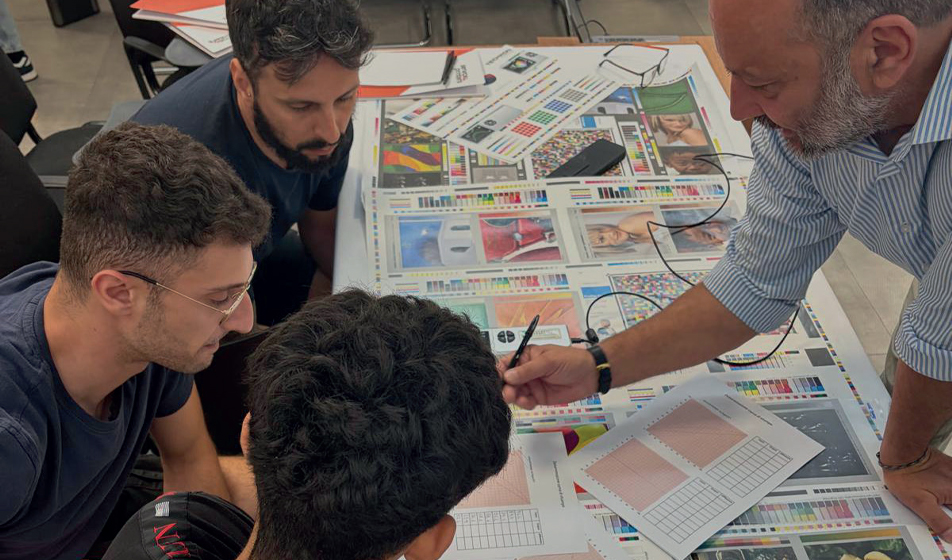
With fewer meters per job, every start-up carries a higher impact. For this reason, the use of the spectrophotometer is reaching beyond the lab and directly into the production workflow: measurement, comparison against the standard, correction, and reporting must become rapid, repeatable steps. The CxF3 format, now an ISO standard, allows spectral data to be transferred across the supply chain, making color less dependent on physical samples.
The trend is moving toward handheld or inline instruments connected to formulation software, color libraries, and quality control systems, capable of reducing visual adjustments, set-up times, and customer complaints. The real issue is not owning a spectrophotometer, but integrating it into a shared methodology and training press operators.
From machinery to procurement
In the coming years, narrow web competitiveness will rely heavily on integration: automated presses, UV-LED curing, digital color control, more precise ink management, and procurement platforms offering clear visibility into stock levels and delivery times. In this context, Converting Magazine and T&K launched a new research project to measure how widespread these practices already are in Italy and where technological or cultural gaps persist. The key factor will not just be which technologies enter the pressroom, but how quickly materials, data, and technical support can move forward together.
Three questions for T&K
What are the main procurement challenges in the narrow web sector today, and how have they changed in recent years?
The center of gravity has shifted from price to production continuity. With more SKUs and shorter runs, orders are no longer placed weeks in advance: the supplier’s lead time becomes the converter’s lead time. Added to this is batch-to-batch consistency-a variance in color or ink reactivity translates directly into additional setup time and waste-in a market that, according to FINAT, recovered some volume in 2024 but has not yet restored the margins seen in 2016.
Because of this, inventory is no longer just a cost; it is the customer’s primary production tool. With 4 locations in Italy, 2 mixing stations, and shipping within 24/48 hours-including custom flexo and UV/LED offset color matches within 24 hourswe build availability rather than a mere price list.
How integrated is the spectrophotometer within the production workflows of Italian label converters today?
We observe three distinct levels. At the first level, the instrument exists but remains in the laboratory: it is used to certify a batch or resolve a dispute, but it does not enter the live production process. At the second level, measurement, comparison, and correction become repeatable steps-this is where the CxF3 format, now an ISO standard, comes into play reducing the need for physical samples. At the third level, instruments are connected to ink formulation software, and the data feeds directly back into ink production.
The majority of Italian label printers currently find themselves between the first and second levels, with a segment of excellence already operating at the third. The bottleneck is not represented by the equipment but by methodology and operator training. This is the exact territory where we operate as a sister company of Tecnologie Grafiche and as the exclusive distributor for Techkon and Datacolor: we do not just sell the instrument, we guide the company through its integration into the production process.
To what extent can the purchasing of consumables and equipment be digitized without losing the value of technical consulting?
You can digitize the transaction, but not the decision. Reordering, stock and delivery time visibility, technical documentation and shipment tracking: this is how a platform reduces urgent orders-and their associated costs. What is left out of this purely digital approach-and must remain so-is selecting the right ink for a new substrate, choosing the correct anilox roll, ensuring compatibility with the curing cycle, and defining a color standard with the brand owner.
That is precisely where a distributor sets itself apart from a pure e-commerce platform: automated orders and reorders are processed within 24/48 hours, freeing up valuable time that our technicians can reinvest on-site, right alongside the customer-something no portal can replicate.