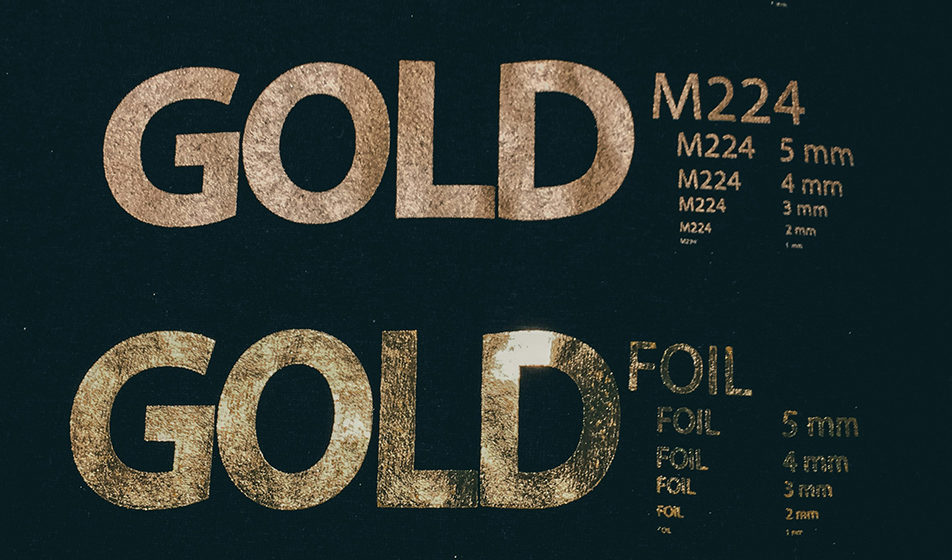
Hot stamping, which uses a foil, was invented by the German Ernest Oeser, who registered the first patent in Germany in 1892. Ernest Oeser’s patent was for a printing machine that, at the time, used gold-foil sheets.
The technology is an evolution of the ancient art of “gilding,” used primarily in bookbinding to add value to books; between 300 AD and 500 AD, people began embellishing parchments with gold
leaf, and it was not until around 1300 that gold leaf began to be used to embellish manuscripts, as described by Cennino di Andrea Cennini (????–1398) in his vernacular book *Libro dell’Arte*.
The gilding of books and leather originated in Persia and arrived in Italy thanks to merchants. True gold leaf gilding, applied by hot stamping to leather bindings, developed in Italy – particularly in Florence and Venice – in the late 1400s.
Cold techniques were used until the late 1700s, but the use of hot application gained traction starting in the early 1800s. Oeser’s invention enabled the industrialization of the process, which saw rapid development starting in the early 1950s, when the first hot-stamping rolls appeared, quickly replacing individual sheets.