
The converting company based in Lombardy kicks off a new plant dedicated to flexographic printing with the arrival of Bobst’s Vision CI. Strategies, tools and skills of a converting business that is structured as a design partner to create efficiency and sustainability. Interview to Alberto Palaveri with Emilio Alliegro and Sara Alexander.
Sacchital – a converting company with a strong R&D vocation, a historical focus on paper packaging and a long history of excellence in rotogravure printing, mis launching a new 2,200 square metre department in Pregnana dedicated to flexographic printing equipped with a brand new Bobst Vision CI.

ALBERTO
PALAVERI
Executive Member
of the Board
@Sacchital Group
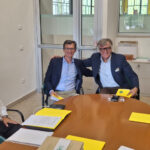
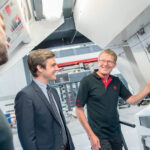
Designed and followed in detail by the Sacchital management and the participated assistance of Emilio Alliegro, Sales Manager Flexible Packaging at Bobst Italia, this new site represents an important piece in the company’s development program, in which the Bobst flexo printing machine is not only a technological investment but becomes part of a long-term structural project.
Alberto Palaveri’s comment
“This is a space designed to accommodate 4 flexo machines and related technologies, which places the Pregnana Milanese site – currently using less than half of the available surface area – at the centre of the Group’s growth plans”, explains Alberto Palaveri, executive member of the Sacchital Group Board, director of the Ǻkerlund & Rausing subsidiary and active in the Paper and Graphics Federation with the dual role of President of Giflex and Vice President of Assografici.
“In addition to installing our first digital machine, for faster service and a high level of customization, and intensively investing in the revamping of all rotogravure systems for state of the art performance, we have launched an ambitious flexo enhancement plan to be able to offer an increasingly differentiated and fragmented market everything it asks for. And sometimes even what is not yet asked for, because it is still not know fully what can be done, more effectively and at a lower cost”.
This today is the task of a converting company according to Sacchital: “We are packaging designers, that is consultants and innovation partners, equipped with the most advanced skills and tools to be able to support our customers in their packaging projects”.
A role that the Group based in Pregnana has built with methodical lucidity by investing in skills, supply chain relationships and state-of-the-art diversified plants. And it is precisely this variety of technologies that allows Sacchital to guarantee its customer what they want, with qualitatively virtually identical results for the three types of rotogravure, flexographic and digital printing tecnologies.
The timing and complexity of doing business
”We want to be able to create the products we want with the quality and efficiency we want”, summarises Palaveri, that is: “on all types of substrates with all inks, finishing, sealing and colour management methodologies – with maximum sustainability and at the required speed”.
A speed measured in weeks when talking of rotogravure printing, in days when flexography is involved “and if we consider that we have customers in the United States who change even 15 jobs a day, we can understand the importance of the time factor in our service capacity”.

Sara Alexander, Marketing & Communication Manager Flexible Packaging at Bobst
This need for speed – comments Sara Alexander, Marketing & Communication Manager Flexible Packaging at Bobst – reflects a broader social trend on a global scale. “Everything is moving fast: processes, innovation, people (especially young people), communication. People no longer have time, and at work, customers want quick answers in every sector.’
And this is not the only stress factor for suppliers of goods and services, who have to make choices and plans without clear prospects on matters such as energy costs or the space that PPWR will open up for different materials, consumption trends and major international issues that open (or close) markets.
But also, considers Alberto Palaveri, a paradoxical ‘excess of opportunities’ for a multifaceted packaging, ranging from the most standardised and recognisable versions to highly customised ones, tailormade for the customer. And while Sacchital has unhesitatingly focused on lightweight, flexible, single material and easily recyclable packaging with increasing percentages of paper in terms of sustainability, the complexity of trends and demand patterns is behind Sacchital’s decision to enrich its offering by equipping itself with all the necessary tools.
“The Group aims to consolidate its core sectors, starting with bakery and related products, to grow across a broad spectrum in the pharmaceuticalnutraceutical and parapharmaceutical sectors, as well as in household and personal cleaning products, transitioning traditional packaging from plastic to paper. But it also aims to develop innovative projects in other non-food and food fields, always with paper-based structures.”
Those 10 metres of start-up
The role of the technology supplier is evident in this business concept. “Innovation is a supply chain effort, and converters need both technology partners to help them stay up to date on the various elements of the printing system and awareness and expertise about the production systems used by their customers – those companies who too often still work with obsolete machines, a real (negative) “filter” of possibilities. This is why the partnership with Bobst is strategic: at stake is not only trust in the brand and in people like Emilio and Sara, but also and above all the willingness and ability to work together, testing materials and products, developing technical solutions and ensuring the presence of technicians and consultants active in the field.”

EMILIO ALLIEGRO
Sales Manager
Flexible Packaging
at Bobst Italia
‘Working with Sacchital is a source of pride,’ says Alliegro, “because it is a technologically advanced company with a bold and forward-looking positioning that demands the best on all fronts: the performance and reliability of the machine and the technical substrate that Bobst guarantees directly in Italy, from Piacenza, San Giorgio and other centres of expertise. This new Vision CI machine is not only considered an opportunity for a technological leap forward, but also a factor in enhancing the overall workflow, and therefore the productivity and global efficiency of the plant.”
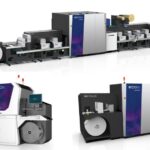
Sacchital chose it first and foremost for its ‘lightning-fast’ set-up. “When Giuseppe Candia, the Group’s Production Manager, and his team came to Bielefeld to see the Vision CI, their attention was immediately drawn to the Smart GPS. This is a proprietary Bobst technology that allows start-ups with very little waste (10-12 metres, Ed.), reducing costs and process times with the associated benefits in terms of efficiency and sustainability.This is a key element in ensuring speed, mwhich is one of the main distinguishing features of flexography.”
Water-based printing and ECG
Another preferred feature, adds Palaveri, is the machine’s ability to work with solvent and water-based inks, with separate washing circuits: “When market and legislative conditions allow, we will be ready to print all substrates with water-based inks, making a concrete contribution to increasing the sustainability of packaging, which remains a core value for us. The Bobst Vision CI was therefore a long-term investment in a system with ma long technological life.
This includes the possibility of working with Bobst experts on other aspects of the workflow, starting with the management of seven-colour inks, which, once fully operational, could greatly increase the rationality of the process, but also on finishing, varnishes, heat-sealing materials, etc. The goal is always the same:
to be able to create products with the characteristics we want, without having to settle for less. Providing customers with print proofs where they cannot perceive the difference between the technologies used, so that we can then discuss the sustainability and cost-effectiveness of the product and how to make it.”
‘And here too, there is harmony between our two companies,’ emphasises Sara Alexander. ‘At Bobst, we are committed to designing and manufacturing the tools that are needed and will be needed to break new ground. Changing approaches mand tools requires time, commitment, mresearch, testing… and it is a supply chain effort, in which we involve customers and technology partners. That’s why anyone who buys a Bobst machine, whatever the technology and for whatever application, knows that they are buying an open system, capable of doing what is required today and ready for what will come tomorrow’.